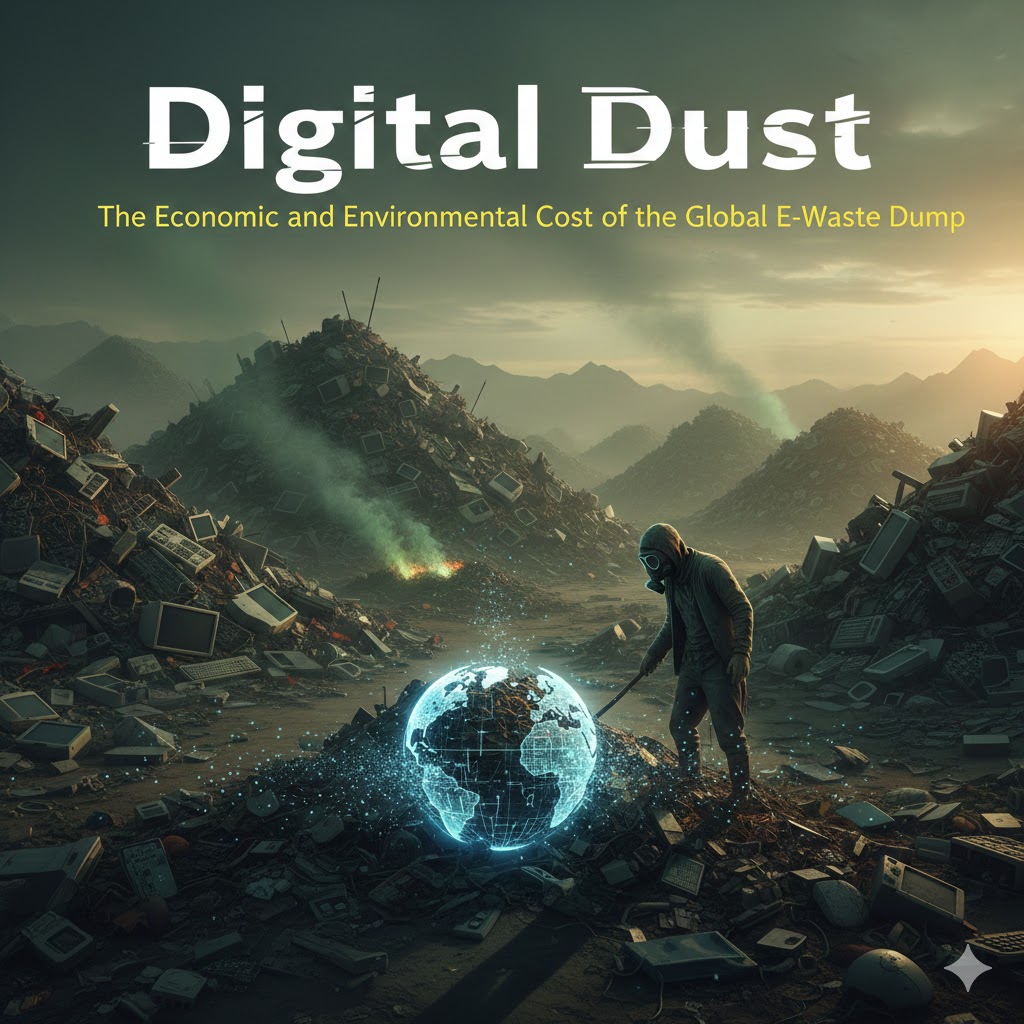

In our relentless pursuit of the new, the faster, and the smarter, we’ve collectively paved a digital superhighway of innovation. Yet, beneath the gleam of every new smartphone, ultra-thin laptop, and AI-powered gadget, lies a burgeoning shadow: the global e-waste dump. This isn’t just an unsightly pile of discarded electronics; it’s a silent, toxic tsunami, carrying immense economic losses and devastating environmental consequences. We are, quite literally, drowning in digital dust and the cost is far greater than we often acknowledge.
The Accelerating Avalanche of E-Waste
E-waste, or electronic waste, encompasses all discarded electrical and electronic equipment (EEE). From colossal data servers to a tiny broken earbud, everything falls into this category. According to the United Nations (UN) Global E-waste Monitor 2024, a record 62 million tonnes of e-waste were generated in 2022, an 82% increase since 2010. E-waste is rising five times faster than documented recycling rates, with only 22.3% of e-waste properly collected and recycled in 2022. The total is on track to reach 82 million tonnes by 2030.
This exponential growth is driven by several factors:
- Planned Obsolescence: Products are often designed with a limited lifespan, encouraging frequent upgrades.
- Rapid Innovation: New technologies emerge at an astonishing pace, making older models quickly redundant.
- Affordability: Electronics have become more accessible, leading to higher consumption rates globally.
- Lack of Repair Culture: Repairing broken devices is often more expensive or difficult than simply replacing them.
The Economic Drain: A Treasure Trove in the Trash
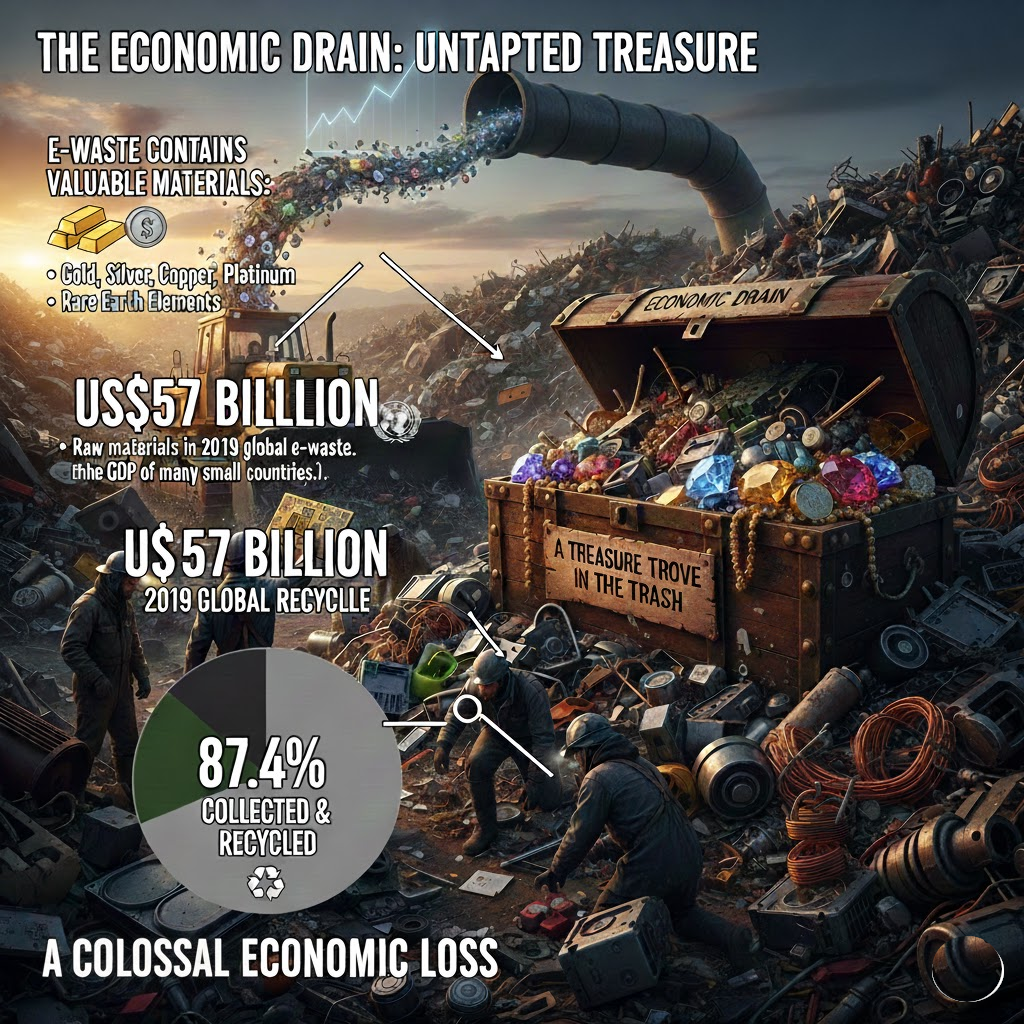
Beneath the surface of this discarded heap lies a hidden treasure. E-waste contains valuable materials, including gold, silver, copper, platinum, palladium, and rare earth elements. The UN estimates that the raw materials in the e-waste generated in 2019 alone were worth approximately US$57 billion. To put this into perspective, that’s more than the GDP of many small countries.
Yet, a paltry 17.4% of this e-waste was officially documented as collected and recycled. The vast majority – 82.6% – was either improperly disposed of, incinerated, or languished in landfills. This represents a colossal economic loss. Every tonne of e-waste that isn’t properly recycled means:
- Lost Revenue: Manufacturers miss out on valuable secondary raw materials, increasing their reliance on virgin mining.
- Increased Mining Costs: Extracting new metals from the earth is far more energy-intensive and environmentally damaging than recovering them from e-waste.
- Supply Chain Vulnerability: Dependence on a limited number of countries for virgin critical minerals can create geopolitical risks and supply disruptions.
Imagine if we could effectively capture and reintroduce even half of that US$57 billion back into the economy. It would spur green industries, create jobs in recycling and materials science, and reduce our ecological footprint.
The Environmental Catastrophe: A Toxic Legacy
Beyond the economic waste, the environmental costs are horrifying. E-waste is a cocktail of hazardous substances, including lead, mercury, cadmium, chromium, and brominated flame retardants. When these devices are improperly discarded, especially in informal recycling operations prevalent in many developing countries, these toxins leach into the soil, contaminate groundwater, and are released into the atmosphere.
- Soil and Water Contamination: Heavy metals can persist in the environment for centuries, entering the food chain and posing severe health risks to humans and wildlife.
- Air Pollution: Burning e-waste, a common practice in informal recycling, releases dioxins, furans, polycyclic aromatic hydrocarbons (PAHs), and heavy metals, contributing to respiratory diseases, neurological damage, and cancer among exposed communities.
- Climate Change Contribution: The energy-intensive process of extracting virgin materials, coupled with the emissions from incinerating e-waste, significantly contributes to greenhouse gas emissions. Conversely, proper recycling can reduce CO2 emissions by replacing virgin material extraction.
The burden of this environmental degradation disproportionately falls on vulnerable communities in countries like Ghana, Nigeria, India, and China, where informal e-waste processing centers operate with minimal safety precautions. Workers, including children, dismantle electronics with bare hands, breathing in toxic fumes and exposing themselves to direct contact with hazardous materials.
Towards a Sustainable Digital Future: What Can Be Done?
Addressing the e-waste crisis requires a multi-faceted approach involving governments, manufacturers, consumers, and innovators:
- Extended Producer Responsibility (EPR): Implement and enforce stronger EPR schemes globally, holding manufacturers accountable for the entire lifecycle of their products, including collection and recycling.
- Design for Longevity and Repairability: Encourage companies to design products that are durable, modular, and easy to repair, upgrade, and disassemble. This includes providing access to spare parts and repair manuals.
- Consumer Awareness and Behavior Change: Educate consumers about the importance of proper e-waste disposal and encourage them to repair devices, donate functional electronics, and choose products from companies with strong sustainability records.
- Invest in Recycling Infrastructure and Innovation: Develop advanced, safe, and efficient e-waste recycling technologies and infrastructure, particularly in regions currently lacking it. Support research into urban mining techniques.
- Combat Illegal E-Waste Trafficking: Strengthen international cooperation and enforcement to prevent the illegal shipment of e-waste from developed to developing countries.
- “Right to Repair” Legislation: Advocate for and enact laws that ensure consumers and independent repair shops have the right to repair electronics, rather than being forced to replace them.
The transition from a linear “take-make-dispose” economy to a circular one for electronics is not merely an environmental imperative; it’s an economic opportunity. By recognizing the value in “digital dust” and investing in its recovery, we can mitigate a growing environmental catastrophe, unlock billions in economic value, create green jobs, and build a more sustainable future for our increasingly digital world. The time to clean up our digital footprint is now, before the avalanche becomes unstoppable.