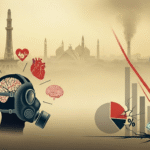
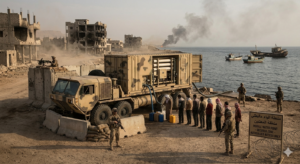

The most strategically significant infrastructure often can be as ordinary as the kitchen tap water-a resource essential for human survival.
The Middle East is gifted with some of the largest oil reserves in the world- pivotal to the region’s wealth, especially for Gulf countries. Traditionally, Gulf conflicts have centered on oil reserves, shipping lanes, military alliances, and nuclear tensions. The Strait of Hormuz, through which one-fifth of the world’s petroleum supply passes has represented the epicenter of global energy insecurity during the conflicts. The longstanding rivalry between Iran, Saudi Arabia, Israel & USA conventionally revolve around Proxy conflicts, resulting sanctions, deterrence strategies and nuclear negotiations. Energy installations, maritime choke points and missile systems remain key instruments to regional powers.
However, in the modern Middle East, a new shift is emerging. Another important natural element- Water is also added to define regional security making it a point of vulnerability.
WHY THE MIDDLE EAST DEPENDS ON DESALINATION
The Middle East and North Africa (MENA) and the Gulf Cooperation Council (GCC) countries are among the most water-stressed regions in the world. Freshwater resources are scarce while demand continues to population growth and the arid climate. Water scarcity results from both geography and human factors (inefficient irrigation practices , water mismanagement and over-exploitation of groundwater resources). Consequently, several states heavily rely on the desalination for more than 70-90% water supply.
Desalination as Engineered Survival
Around 70% of the global desalination plants are operated in the region. Desalination of sea water is essential to meet the growing demand for freshwater. However, the process is costly and energy intensive. Brine is generated as a by-product which can harm the marine ecosystem if not disposed of properly. Advances in desalination technology aim to reduce costs and improve efficiency.
Statistics of Gulf Dependence
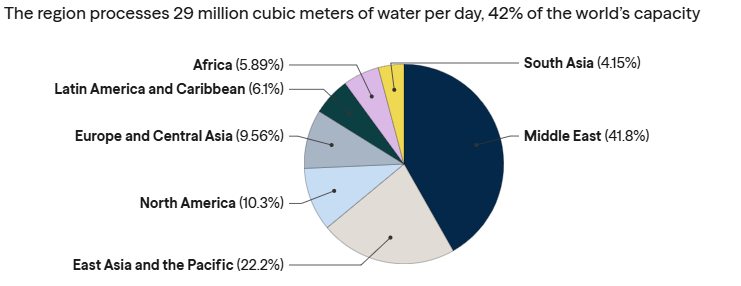
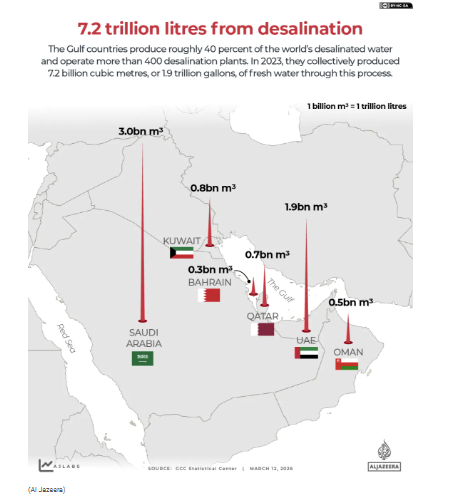
Gulf states particularly-Saudi Arabia, UAE, Kuwait, Bahrain, Qatar produced around 40% of the world’s desalinated water via 400 desalinated plants. This survival dependence has created a strategic fragility. Unlike the oil markets, water disruptions immediately affect public health, civilian survival, industrial activity and governmental legitimacy.
FROM OIL PIPELINES TO WATER PIPELINES
The intensified Gaza conflict, recent escalations between USA, Israel and Iran and the Iranian Proxy Network have prompted Gulf states to treat desalination facilities as the strategic assets requiring military protection. Attacks on these plants could trigger humanitarian crisis because of limited freshwater reserves.
Why Water Creates Panic Faster than Fuel
The World Bank has identified water insecurity as the most significant threats to social stability and sustainable development. Fuel disruptions primarily increase costs and reduce economic activity. The governments often rely on the emergency reserved fuels etc. Contrary to this, water shortages immediately cut off the basic human survival needs- drinking, sanitation, food preparations, healthcare services , public hygiene and psychological distress.
Coastal Geography Dilemma
The desalination plants must be operated along the coastlines to have direct access to the seawater. This geographical placement exposes them to security threats. Across Gulf, critical water infrastructure is situated along relatively narrow coastal corridors which borders the Arabian Gulf. These facilities are highly visible, fixed and difficult to relocate.
Throughout history, control of water has been a strategic objective making it a strategic asset and strategic vulnerability. State and non-state actors can pressure governments by disrupting water supplies without occupying territory. This reflects a broader shift in contemporary conflict.
WATER AS A GEOPOLITICAL WEAPON
According to a study by Gavasheli, M. (Come war or high water: Investigating the weaponization of water through manipulation of dams in the Russia–Ukraine war (2024)) , the concept of water warfare is not only confined to the conflicts fought over water, but it also covers the deliberate use of the water infrastructures and systems as instruments of pressure, strategic leverage and coercion.
Case Studies
i) Qeshm Island: When Iranian Villages Lost Water: Iran’s Qeshm Island is in the Strait of Hormuz. On 7th March 2026, US airstrike targeted the desalination plants which reportedly cut off the water supply to around 30 villages as stated by the Iranian authorities.
ii)The Gulf War’s Forgotten Water Lesson: The Gulf War (1990-1991) , triggered by the Iraq’s Invasion of Kuwait on August 2, 1990 , is marked by the military operations, oil well fires, and regional geopolitical consequences. Less attention was paid to its impacts on the water infrastructure. During the occupation and subsequent conflict, electricity units, industrial plants and public facilities suffered high damages which in turn disrupted the water production and distribution systems. Contemporary policymakers can draw important lessons from this conflict.
INTERNATIONAL LAW
According to the 1949 Geneva Convention and Additional Protocol I (1977) , the civilian infrastructure that is indispensable to the survival of the civilian population must receive special protection. The importance of protection has increased amidst the ongoing conflicts where these protocols are significantly violated.
But grey zones also exist as modern infrastructure (energy-water systems) including the desalination plants serve both the civilian and military purposes. It’s legality has become a highly contested debate between the military planners and the humanitarian organizations.
Moreover, the application of international law is becoming increasingly difficult with the rise of hybrid warfare (physical disruptions, proxy actors, disinformation, psychological, cyberattacks and economic sanctions).
In the Gulf region, this challenge is more evident as the desalination plants are heavily integrated with energy infrastructures.
GULF REGION RUNNING DRY AMIDST THE CLIMATE CHANGE
According to the World Meteorological Organization (2024), Middle East is warming at nearly twice the global average in some locations. The average summer temperature already exceeds 50°C in parts of Iraq, KSA, Kuwait and UAE.
Rising temperature increases demand for agriculture, cooling systems, drinking, which puts pressure on the fragile water resources . This is the Environmental Cost of Desalination. Moreover, conflicts and climate change are colliding with each other affecting geopolitical stability.
CAN THE GULF PROTECT ITS WATER FUTURE?
The point of concern for Gulf countries is whether they can sustain the desalinated water supply during the crisis. Several Gulf countries have been investing heavily in emergency reserves of water. The UAE’s Water Security Strategy 2036 aims to increase the national water storage capacity and to ensure emergency water supplies. Saudi Arabia is also investing in storage networks and reservoirs to maintain water availability even. However, this is a temporary solution as emergency reserves only buy time.
Cybersecurity and Infrastructure Defense
Increasing digitalization has made desalination facilities susceptible. Cybersecurity and Infrastructure Security Agencies identified the water systems as the potential target to the state-sponsored actors and cybercrime groups. Recognizing this threat, Gulf countries are building cyber resilience. For instance, Qatar’s Critical Infrastructure Protection Program (CIP), UAE’s Cybersecurity framework and Saudi’s National Cybersecurity Authority. These frameworks will help strengthen the protection of water infrastructure by continuous risk assessment , effective reporting, cybersecurity monitoring and resilience measures. Moreover, the ability of the desalination plants and water distribution channels to detect , respond and recover from any cyberattacks that could disrupt water supplies will also improve.
Regional Diplomacy vs Fragmentation
Despite the shared environmental and desalination challenges, water security policies in the region are mostly treated as national rather than regional. Each country is working on its own projects, frameworks, storage facilities and protection strategies. Hence, there is no comprehensive regional framework. This offers limited regional cooperation despite the rapid national development.
CONCLUSION
Water is the defining security layer of the future Middle East. And desalination plants are the new frontline assets There is now a growing dependency on the desalination plants amidst the growing population, water scarcity and climate change. However, this reliance is also creating vulnerabilities making water infrastructure a potential target in modern conflicts. This intersection of geopolitical uprisings and environmental stress outlines the growing importance of the the water security for regional stability. Ultimately, as modern warfare is increasingly about control of life-support systems, not land.