
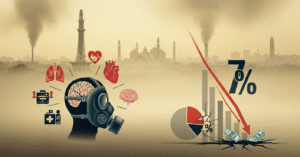

Pakistan isn’t breathing. The annual smog suffocates Pakistan causing societal disruptions. This silent toxic blanket doesn’t just halt life but inflict a hidden trillion-rupee economic drain.
In cities like Lahore, which ranks 2nd most polluted city in the world, the visibility drops, erasing the dense urban landscapes. Real-time Air Quality Index (AQI) data for Lahore during this season in Pakistan, reveals the pollutant concentrations beyond the ‘Hazardous’ range of 300 points.
SMOG AS FIFTH SEASON & VISIBLE COST OF HEALTH CRISIS
In Pakistan, the smog has become The Fifth Season particularly from October-January. Metrological Factors: Temperature Inversion and Low Wind Speeds during post-monsoon and early winters act as an insulation. The trapped air concentrates the man-made emissions into toxic haze.
Fine Particulate Matter (PM2.5) is the main culprit. They can be inhaled, reaching the lungs and bloodstreams. The PM 2.5 levels in Lahore are recorded to be 68 µg/m3 (155-Unhealthy AQ, WHO).
Public Health Overload: 90% of the population in the low- and middle-class countries suffers from high levels of pollution exceeding the WHO guidelines limit.
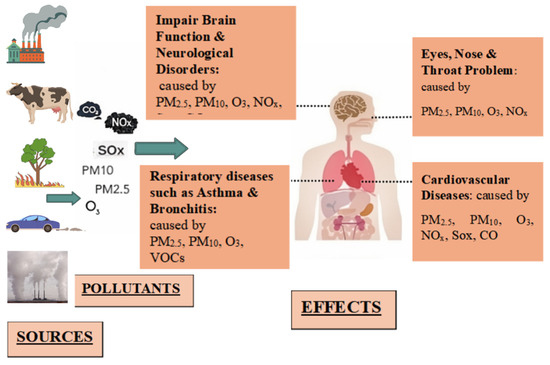
Consequently, these pollutants cause severe cardiovascular and respiratory infections, allergies, lung cancer, eye and throat issues and mortalities. It also influences mental health leading to a cognitive decline.
Children and elderly are more vulnerable due to weak immunity. University of Chicago’s Air Quality Life Index (AQLI) estimates that the residents of the most polluted cities of Pakistan could lose 5.3% of life expectancy if the situation persists
SMOG AS A FINANCIAL EMERGENCY
Air Pollution including smog has imposed heavy burden on citizens and the struggling economy. The annual cost is 7% of its GDP. This translates into the ‘Trillion Rupee Economic Drain’ per year. This hidden ‘Smog Tax’ is paid across three pillars.
1) Productivity and Labor Loss:
Governments take measures like reduced market hours, enforced industrial shutdowns, closure of schools and motorways, flight delays or cancellations. This immediately halts economic activity and disrupts commerce and supply chains.
Secondly, Decline in labor productivity. Workers frequently suffer from respiratory issues, headaches, fatigue etc. due to poor air leading to sick days and reduced efficiency. The loss of human capital efficiency causes economic burden.
2) Agriculture and Food Security:
Agriculture is the backbone food security in Pakistan. It contributes 21% of GDP. Research in the agricultural districts of Punjab confirms a loss of staple crops yield (rice and wheat) by 10% to 30% due to smog. This creates a food shortage and inflation of the basic commodities.
Farmers practice burning the crop residue before the next sowing season. Burning contributes to the smog and damages the future yields. This is a costly cycle.
3) Healthcare System Strain:
Smog poses financial stress on the national treasury and households, especially low-income families. Healthcare system faces surge in patients (1.9 million on average in Punjab), straining the budget forcing families to bear the expenses of smog related health issues.
WHY THE CRISIS PERSISTS
Inconsistent environmental regulations and infrastructure development amplify smog. Local anthropogenic activities are also the contributors to dominating atmospheric toxins.
Local culprits are;
1) Vehicular Emissions:
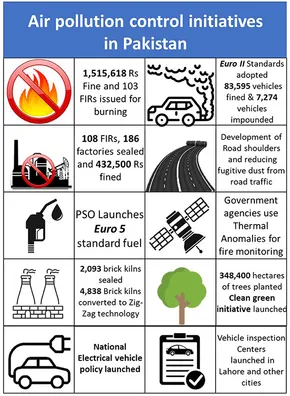
Transport sector in Pakistan remains the largest contributor of urban air pollution. Majority of vehicles are below the Euro 2 emission standards. Pakistan Environmental Protection Agency (EPA) introduced Vehicular Emission Control Action Plan (VECAP). It involves Electric Vehicle Promotion Program (EVPP) and third-party emission testing.
2) Industrial/Brick Kilns:
The industrial sector relies on inefficient energy practices. Brick kilns use the outdated Fixed Chimney Bull’s Trench Kilns (FCBTKs). The Punjab’s Smog Mitigation Plan 2024 aims to reduce the brick kilns emissions by 60% per kiln and utilize a cleaner Zig-Zag Kiln technology.
3) Urbanization & Deforestation:
Deforestation, inefficient waste management, urbanization, road construction, and infrastructure projects also contribute to the volatile organic compounds (VOCs) and the particulate matter (PM)-components of the smog.
Trans-boundary Factor
It refers to the contribution of the pollutants generated outside Pakistan. The smog is also a regional crisis (India, Nepal and Bangladesh along with Pakistan). Seasonal burning (October-November) of the agricultural waste like rice stubble in Haryana and Punjab (India) are the trans-boundary source. Massive plumes of smokes-PMs and Black Carbon, are carried towards Pakistani cities like Faisalabad, Lahore, Sialkot etc. However, in comparison local emissions throughout the year are still the primary source.
PATH TO CLEAN AIR & STRATEGIC SOLUTIONS
The smog crisis being multifaceted demands an all-encompassing year-round smog management and emission mitigation. Instead of reactive smog days closure, continuous monitoring is needed. Sites inspections, fines for violations, and closure in case of non-compliance are crucial.
Green Transition:
Vehicles must be regularly inspected. Ban should be imposed on vehicles lacking fitness certificates or excessive emissions. Schemes like National Electric Vehicle Policy (NEVP) are vital. The government is promoting electric vehicles like EV bikes low, 1% sales tax.
Industrial Efforts are underway to convert brick kilns into modern Zig-Zag Kilns.
The Agriculture Department promotes the in-situ residue management to reduce the stubble burning by providing the farmers with the Rice Straw Shredders and Subsidized Super Seeds (Smog Control Strategy 2024-2025).
Climate Diplomacy:
Given the trans-boundary nature of the smog unilateral actions are insufficient. Bilateral Cooperation with India in climate diplomacy is crucial to manage the regional smog. A Joint Task Force should be established for regional air quality monitoring and mitigation. There is also an opportunity for environmental peacebuilding. The World Bank stated that the trans-boundary measures can reduce the total individual cost by 45% and fosters environmental peacebuilding.
CONCLUSION: A CHOICE BETWEEN HEALTH AND STAGNATION
The persistent smog in Pakistan is a systemic economic catastrophe not merely a health emergency. It is a dual crisis. The environment is deteriorating the health and wealth of the nation. Focusing on immediate, reactive action is insufficient. It is a long-term economic imperative, requiring sustainable vigilance and investment for GDP growth. Implementing Cleaner Industrial measures, Strict emission standards, waste management, modernizing agricultural practices, reforestation and engaging in climate diplomacy are essential. Environmental restoration will recover trillions of rupees lost in national treasury. Pakistan economic future can be secured by securing the right of its citizen to breath clean air.





I liked the post, a well structured and very thoughtful
We need an immediate action on this problem as it is deteriorating the physical and economic health of the country.; Pakistan is a developing country with 60% of its population is relatively young. Pakistan produces less than 1% of carbon emission and still it is one of the most climate vulnerable countries. and Yet cities like Lahore and Karachi are ranked among the most polluted cities in the world. We as a nation are choking under severe smog despite country minimal role in carbon emission output. We strongly need environmental governance.