

In the complex world of global economics and geopolitical strategy, a quiet revolution is happening. It is driven by the essential materials beneath our feet: critical minerals. Rare earth minerals contain rare earth elements. There are 17 of these elements, which are malleable and easily shaped without breaking during manufacturing. These commodities are crucial for powering items like smartphones, electric vehicles, defense systems, and renewable energy technologies. A “Rare Earth Race” is building up involving the United States, China, and Africa, which is significantly changing economic power and international relations.
Previously, these minerals were taken for granted until China strategically consolidated its dominance in their extraction, processing, and refining. The International Energy Agency (IEA) estimates that China accounts for about 61% of rare earth production, including cobalt, lithium, and graphite, and 92% of their processing. This has alarmed the USA, which increasingly recognizes its dependence as a significant national security and economic risk.
China’s Strategic Maneuver: A Head Start in the Race
China’s foresight in the critical minerals sector was not a coincidence. For the past thirty years, Beijing has invested a lot in exploring, mining, and processing these elements, both at home and overseas.
Chinese strategy involved developing better metallurgical techniques to process complex ores and creating a strong domestic supply chain. Further, they invested in mining projects around the world, especially in Africa, to ensure long-term access to raw materials. This often included major infrastructure projects, building roads, railways, and ports that helped local economies and made it easier to export minerals. Moreover, China is taking advantage of lower labor costs and relaxed environmental regulations (though this has started to change at home) to provide competitive prices.
The result is a significant advantage. China doesn’t just mine the raw materials; it controls the whole value chain, from extraction to refining and the production of advanced components. This gives Beijing a lot of power, as shown by previous times when it has limited rare earth exports to push its political agenda.
The United States Plays Catch-Up: A Renewed Focus on Supply Chain Resilience
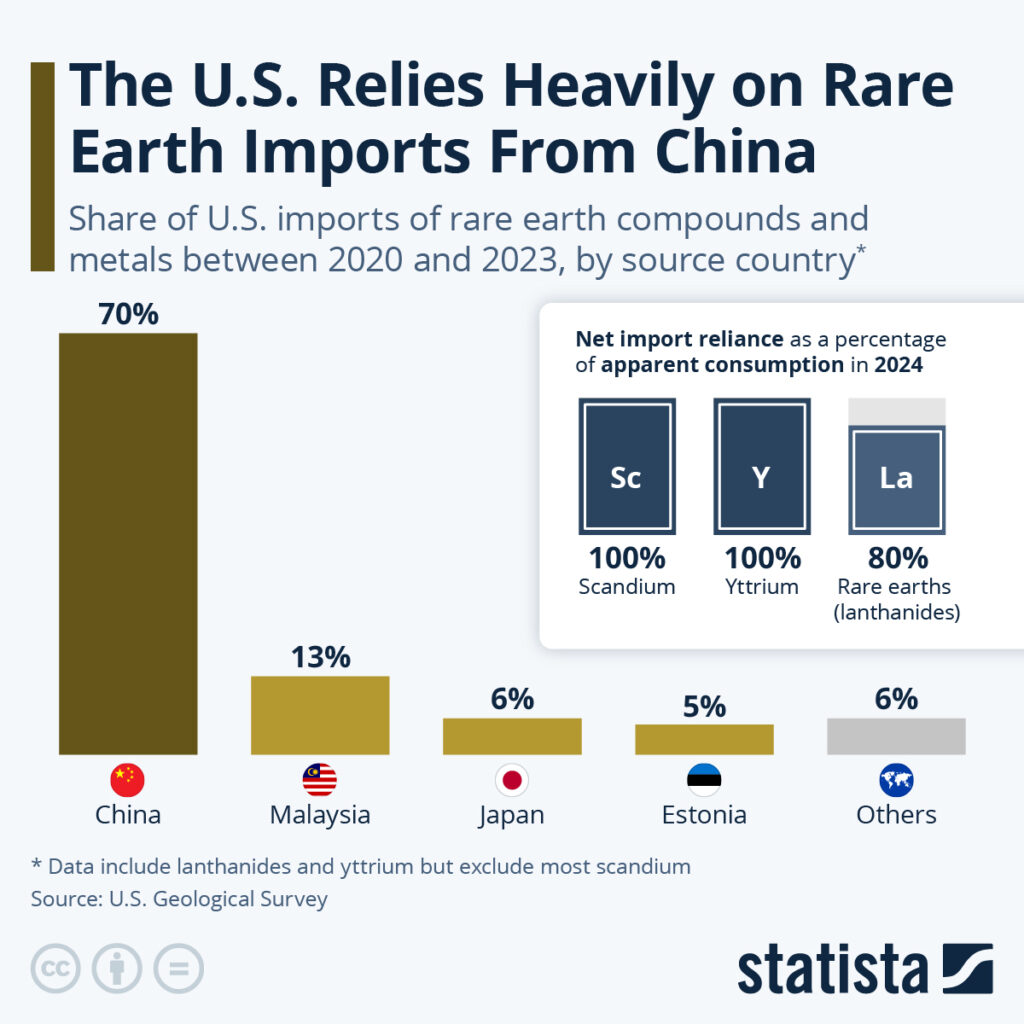
The U.S. is heavily reliant on rare earth imports from China, which accounted for 70 percent of U.S. rare earth imports between 2020 and 2023. The other main suppliers are Malaysia, Japan and Estonia Yttrium, one of the elements covered by the new rules, is almost exclusively sourced in China, with 93 percent of Yttrium compounds brought into the U.S. between 2020 and 2023 coming from China. According to the U.S. Geological Survey, the U.S. is 100 percent import reliant for Yttrium, which is primarily used in catalysts, ceramics, electronics, lasers, metallurgy and phosphors.
The U.S. has recognized that its economic future and national security depend on reliable access to these minerals. There is a sense of urgency to strengthen supply chains and invest in domestic infrastructure. The country is forming partnerships with Australia, Canada, and European nations to develop new mining and processing facilities. It is also searching for new deposits within the U.S. and investing in new technologies for extraction and refining, aiming to bring some processing back home. The goal is to create reserves of critical minerals to lessen the impact of sudden supply disruptions. Additionally, the U.S. is looking to Africa, which has untapped mineral resources.
Africa: The Epicenter of the New Great Game
Africa is estimated to hold about 30% of the world’s mineral reserves. That includes large amounts of cobalt from the Democratic Republic of Congo, lithium from Zimbabwe and Mali, graphite from Mozambique and Tanzania, and a range of rare earth elements. For years, China has been the leading foreign player, building strong economic connections through significant investments in mineral infrastructure and other sectors, often via its Belt and Road Initiative.
One of the criticisms of the Chinese model is that while it has built infrastructure for minerals extraction in various African countries, however, it has overlooked governance issues. Moreover, there are growing concerns about debt traps and environmental standards. The U.S. and the West are now presenting themselves as alternatives by emphasizing transparent governance, higher environmental and labor standards, private sector investment, and a focus on local value addition. Apparently, U.S. is offering them to develop their own processing and manufacturing capacity that would result in more jobs and wealth locally.
2025 is predicted to be a tipping point for the mining of rare earth minerals in Africa. The continent’s output will make significant strides towards a projected accomplishment of providing 10% of global supply within five years. This begins this year as new mining endeavors in Malawi, South Africa and other countries begin operations.
Challenges and Opportunities
The global competition for controlling rare earth minerals is giving African nations new leverage. Now is the time to negotiate better terms, demand higher standards, and seek partners who match their national development goals. The challenge for African governments is to navigate this complex situation, avoiding new forms of dependency while maximizing benefits for their populations.
Several challenges remain:
- Environmental Concerns: Mining and processing critical minerals can be environmentally intensive. Sustainable practices and responsible sourcing are paramount.
- Geopolitical Instability: Many critical mineral deposits are located in regions prone to political instability, posing risks to supply chains.
- Technological Advancement: Developing new, more efficient, and environmentally friendly extraction and processing technologies is crucial.
- Local Value Addition: Ensuring that African nations benefit from their mineral wealth by moving up the value chain, rather than just exporting raw materials.
Conclusion
The Rare Earth Race is not only about resources, but it is also a contest of economic models that could reshape 21st-century geopolitical power. The terrain is complex, and whoever successfully navigates it could reshape the future global economic order.
Africa could become a hunting ground for world powers where the U.S. is gearing up to reassert its economic leadership, strengthen alliances, and build more resilient supply chains. Whereas China must be looking all these developments anxiously, and to counter those developments, it will be making efforts to solidify its existing advantages while potentially adapting to growing international scrutiny regarding its practices. For Africa, it’s a pivotal moment to leverage its mineral endowment for sustainable development, industrialization, and greater economic sovereignty.