
The development of a global green transition needs batteries, electric cars, and renewable energy materials. These then depend on minerals such as cobalt, lithium, nickel, manganese, graphite, and rare earth elements. The continent holds a vast reserves of these resources, however it exports as ores and imports finished products. Such a development leaves no choice but starts a green debt trap. Major powers such as the USA and China are competing to take advantage of such vital elements by investing with a development mandate. Notably, this is viewed as a new green debt trap with the potential of undermining the sovereignty of several African states.
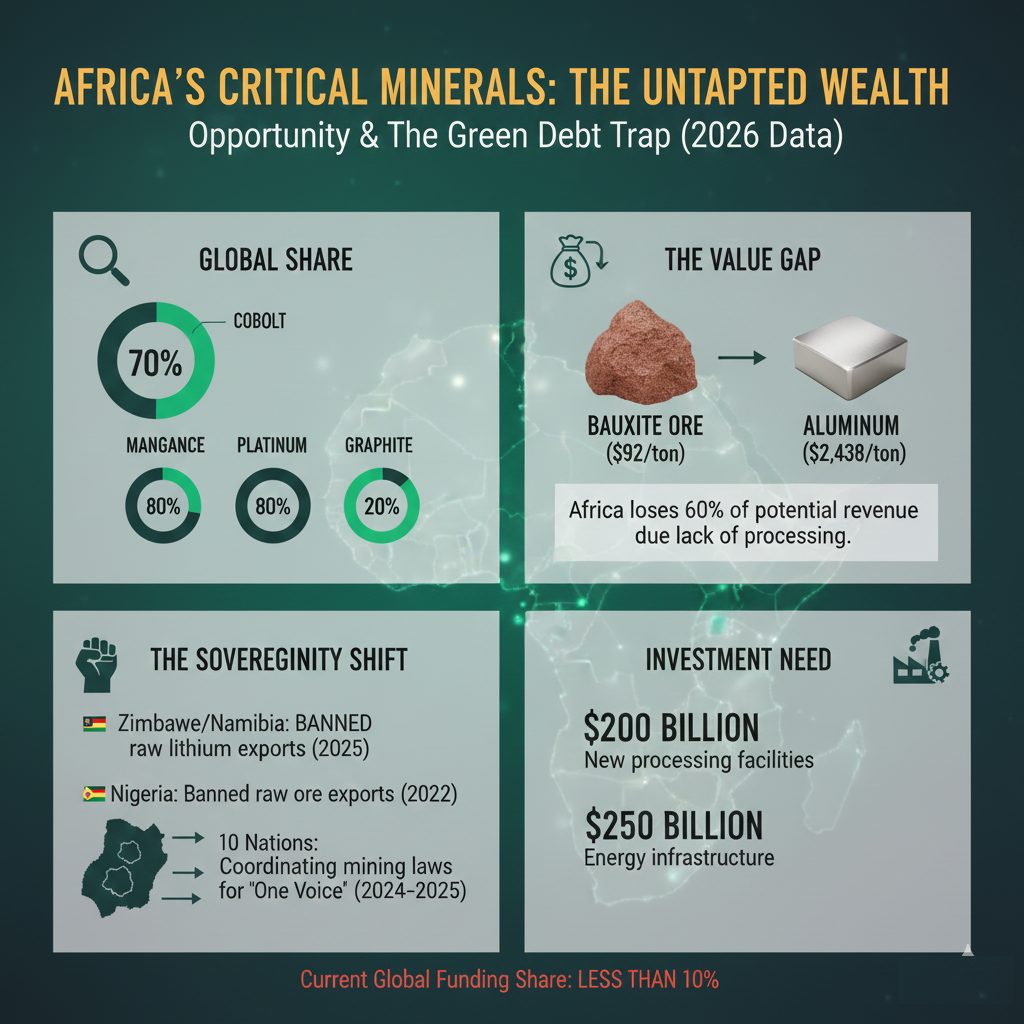
Africa currently accounts for around 30% of the world’s identified critical mineral resources. For individual key minerals required for a low-carbon transition, these percentages are higher:
- Cobalt: 70% of world reserves (in DR Congo).
- Manganese: 80% of world reserves
- Platinum Group Metals (PGMs): 80% of the world’s reserves are found in South Africa and
- Graphite: Over 20% of known reserves.
How the New Green Debt Trap is formed
Three forces combine to create the debt trap.
- Extraction without value capture. Government sell or lease their deposits to foreign companies in return for upfront revenue and loans for infrastructure development. However, the real profits from these deposits include refining, battery production and technology which foreign countries never share. That results in countries become vulnerable to variations in commodity prices, thus losing out on higher-margin value chain stages. (Natural Resource Governance Institute)
- Geopolitical competition and conditional finance. The great powers and companies are competing to lock in supply chains. There are commitments to finance, to build infrastructure, and to quickly buy resources, all often with strings (off-take agreements, priority, and tied financial commitments to contractors). “Development” arrangements often pack high debt costs and strategic burdens.(Stimson Center)
- Rising public debt and weak fiscal buffers. Many African states already suffer from debt stress or limited debt capacity. Large, opaque mining deals or megaprojects financed by loans can push fragile economies over the edge. That in turn will reduce policy space for social spending and development. International lenders’ debt sustainability frameworks exist but are unevenly applied across mineral financing deals. (openknowledge.worldbank.org)
The “Value Gap” (The Price of Not Processing)
The biggest reason for the “Green Debt Trap” is the difference in price between raw ore and finished products.
- Bauxite vs. Aluminum: In 2025, a ton of raw bauxite ore sells for about $92. However, after it is refined into aluminum, that same amount fetches around $2,438.
- Revenue Loss: Sub-Saharan economies currently capture only about 40% of the potential revenue from their natural resources because they lack local processing plants.
Why resource sovereignty matters now
Power over extraction alone is not sufficient. Sovereignty involves policy drivers that shape the entire value chain: licensing agreements, local-content requirements, control of ownership, protection for the environment, transparency, and downstream industrial policy. Countries that manage their own production from start to finish make more money and create better-paying jobs. By doing the work themselves instead of just selling raw materials for loans or building projects, they gain more power on the world stage and avoid falling into heavy debt. (Natural Resource Governance Institute)
Real risks & quick examples
- Processing dominance overseas: Even though Africa mines huge amounts of raw minerals, most of the processing and manufacturing happens in just a few developed countries. Thus such countries keep the maximum profits and hold all the power. This creates a big risk for the rest of the world: if those few suppliers decide to restrict access everyone else loses access to the materials they need.(Policy Center)
- Debt exposure: Big loans for mining or building projects might seem like a good deal at first, but they often become a burden later when it’s time to pay them back. Countries already struggling with debt risk repeating old mistakes trading away their natural resources for roads or bridges that don’t actually help their economy grow in the long run.(openknowledge.worldbank.org)
Three policy priorities to avoid the trap
- Condition access to ore on value-addition.Governments should require or at least offer incentives for processing and making products from minerals right at home. If a country can’t do this alone, they can team up with private companies or use a mix of different types of funding (called ‘blended finance’). This keeps more of the mining profits and ownership in the country. To make this work, leaders should set rules that limit how much raw ore can be shipped out, tax those raw exports, and require that a certain amount of the work is done locally.(Natural Resource Governance Institute)
- Transparent, strategic contracting and revenue management. Governments should make mining contracts public and follow international rules for bringing transparency in the industry. They should also set aside the funds generated from minerals into special sovereign accounts to build local industries. Having clear, open rules makes it harder for people to steal money through corruption and gives the country more power when negotiating deals with foreign companies and other nations. (idea.int)
- Debt-sensible industrial finance. Instead of just taking traditional loans, countries should use special low-interest funding and partner up with investors who share the risk. These deals should only happen if they clearly help local people and if the country can actually afford to pay them back. It is also important to check with global financial institutions (like the IMF or Wold Bank) early on to make sure the debt won’t crash the economy later. In short: choose deals that help the country grow and build its own skills, rather than taking on secret, new green debts trap that the government will struggle to pay off. (World Bank)
Geopolitics: leverage it, don’t be leveraged
World demand also gives African countries leverage. Instead of countries negotiating one against the other to get the best terms in bilateral deals, the use of blocs and consortia allows countries to speak with one voice on terms of trade and investment. This eliminates the “take it or leave it” attitude that one government would normally present. (gepc.or.tz)
A practical roadmap — quick checklist
- Audit national mineral contracts and publish findings.
- Enforce local content and refining milestones in new licenses.
- Create (or strengthen) a sovereign mineral development fund to capture rents.
- Require full debt-disclosure for mining-linked loans and apply DSA criteria.
- Invest in targeted skills, power, and logistics to make downstream industry viable. (Natural Resource Governance Institute)
Conclusion: a strategic moment
The move to green energy is a great opportunity, but it doesn’t guarantee success. It depends on the choices leaders make today. If Africa handles its minerals the same way it has in the past, it will end up in new green debt trap rather than wealthy. This happens when minerals are extravted quickly and sent overseas to be turned into finished products, while the country gets stuck with high-interest loans it can’t pay back. Instead of becoming truly independent, countries risk being under the control of others once again.The choice matters — now. (iea.blob.core.windows.net)