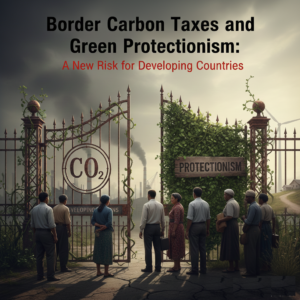

The fight against climate change has reached the customs border. While wealthier nations accelerate their transition to green energy, they are increasingly concerned about “carbon leakage”. These nations fears that carbon-intensive industries will simply move production to countries with weaker environmental regulations to avoid high domestic carbon costs. The European Union and United States are promoting a new trade policy tool known as the Carbon Border Adjustment Mechanism (CBAM) to counter such a problem. Although such a mechanism appears to address climate change, developing countries look at such border carbon taxes from a more sinister perspective: “green protectionism.” In fact, the debate is currently raging on whether such instruments are a real solution directed at a low-carbon future or a potential threat to developing economies.
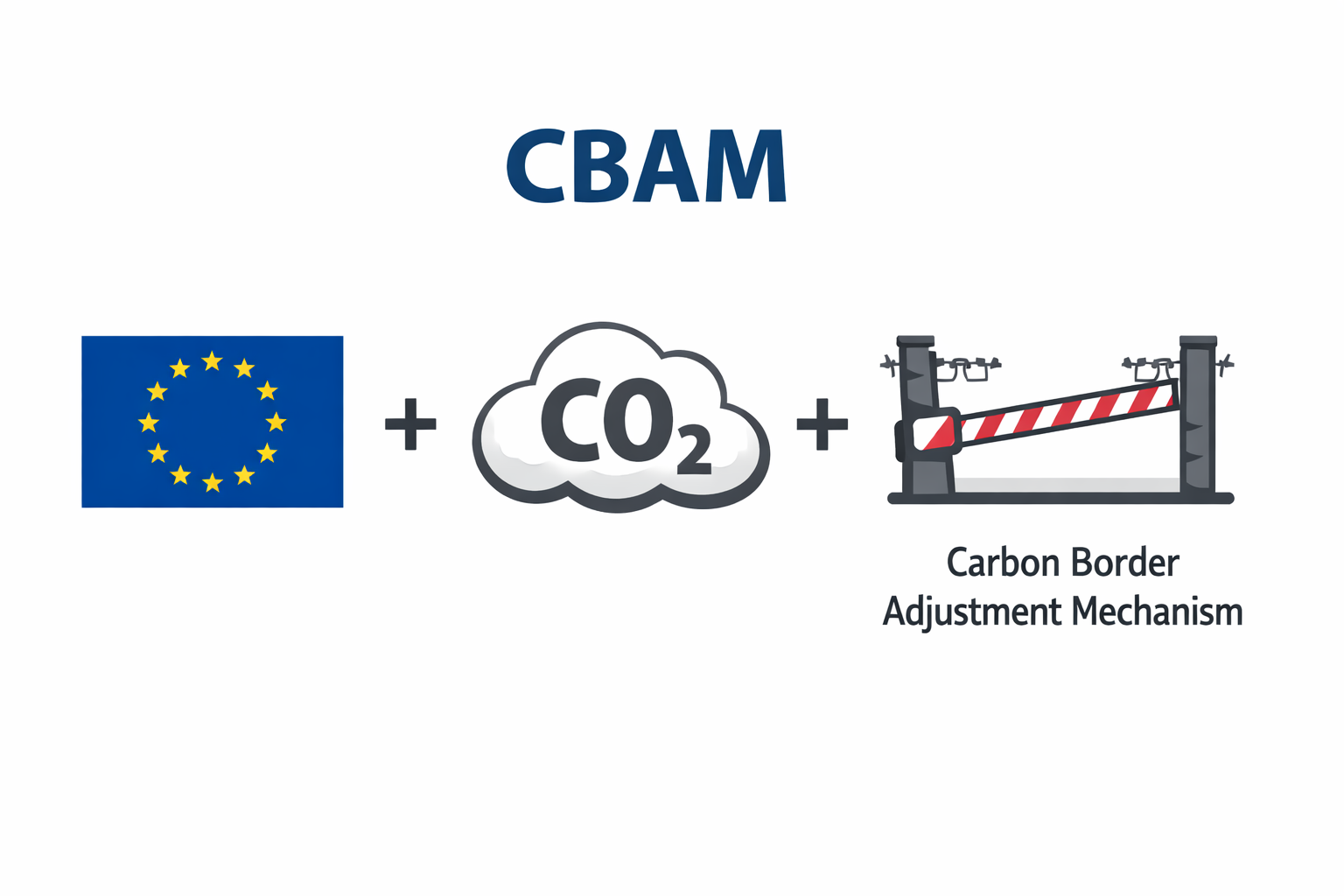
What is the CBAM, and Why is it Controversial?
A CBAM is basically a tariff charged on the amount of greenhouse gas emissions contained in the product that is produced by the country who wish to export to EU or USA. The primary aim of a CBAM is to ensure a level playing field.
In theory, if the EU imposes a high price on carbon for its domestic steel producers, an imported ton of steel from a country without a comparable carbon price would face a CBAM fee equal to the EU’s domestic carbon cost. This removes the cost advantage that foreign, high-emission producers might otherwise enjoy, thus protecting EU industry from unfair competition and preventing local companies from shifting their operations (and emissions) overseas.
Conceptually, if the EU imposes some high price on carbon for its domestic steel producers, an imported ton of steel from a country without a comparable carbon price would face a CBAM fee equivalent to the EU’s domestic carbon cost. This takes away the cost advantage from foreign high emission producers and protects EU industry from unfair competition. It could also potentially prevents local companies from shifting their operations-and emissions-overseas.
The controversy, however, centers on equity and justice, two concepts central to climate negotiations.
- Historical Responsibility: Developing nations argue that Western economies attained their industrialization and wealth by burning fossil fuels for centuries. Placing a punitive tax on their carbon-intensive exports today, when they are still building out basic infrastructure and industrial capacity, ignores the principle of “Common but Differentiated Responsibilities” enshrined in the Paris Agreement. They believe the developed world should provide finance and technology, not impose taxes.
- Capacity and Cost: CBAM compliance is no small feat. There are most definitely high costs entailed by accurate monitoring, verification, and reporting of the complex, embedded emissions of products is an administratively heavy requirement. For SMEs in developing countries, this could be an insurmountable barrier to entry, effectively choking off their access to lucrative markets such as the EU.
The Economic Consequences for the Global South
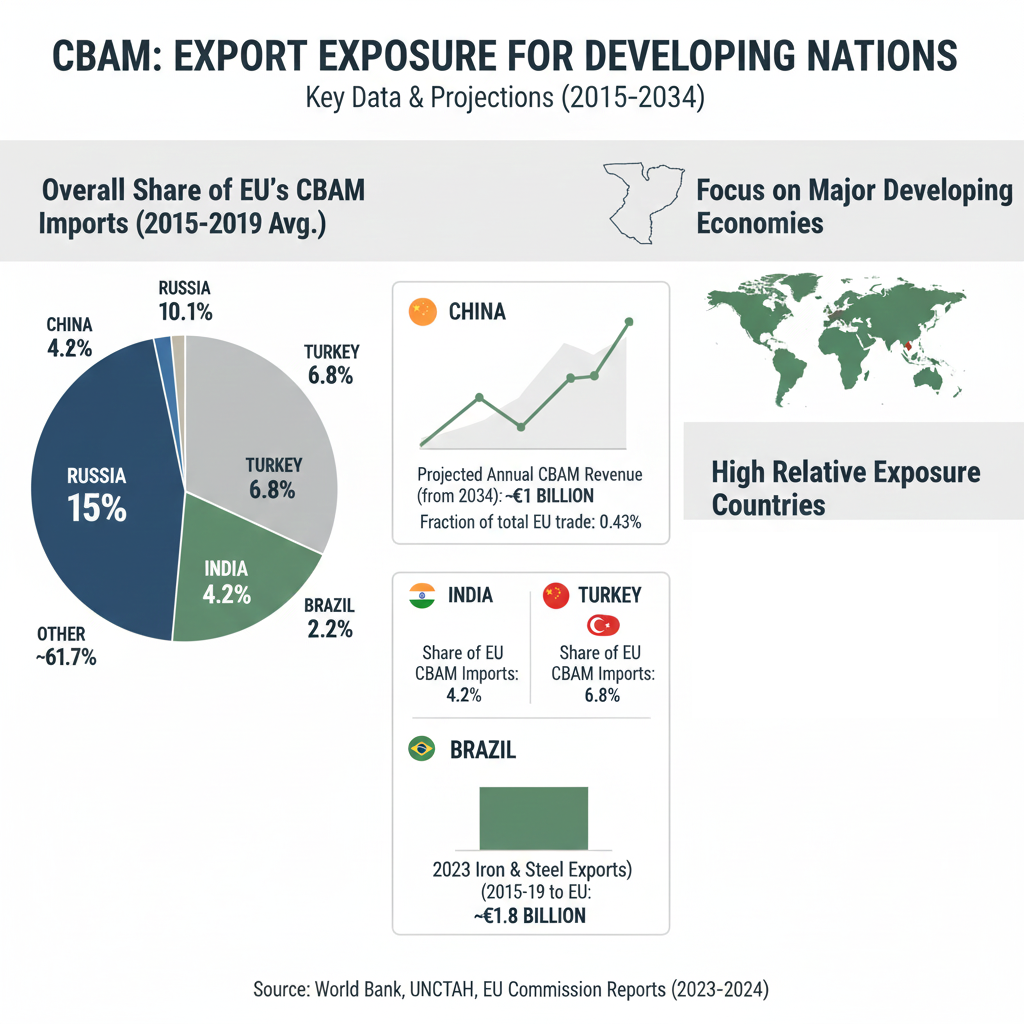
The effects of border carbon taxes are uneven and alarming to developing countries in terms of their implications for the economy. The EU’s CBAM scheme aims to cover the most carbon-intensive sectors: cement, iron and steel, aluminum, fertilizers, electricity, and hydrogen. It is the same sectors where developing countries, in most instances, build the base of their exports and industrialization activities.
- Export Competitiveness Loss: Nations such as India, South Africa, Indonesia, or Mozambique, which export carbon-intensive products to the EU, are expected to face a direct loss of competitiveness in their exports to other nations in future. The impact of the CBAM certificate price can easily destroy their profit margins, making them a costly alternative to other, cleaner, possibly Western, suppliers. Some models suggest a sharp decline in demand for carbon-intensive exports from the most affected regions.
- Hindered Industrialization: For an emerging economy, the export of natural resources is less preferable than the export of industrialized products. This necessary evolutionary process in the global economy is made harder by the CBAM as it adds an extra burden on the invested carbon in the form of customs duties. Thus, it might trap these countries in a never-ending process of exporting commodities of lower value and lower processing.
- Technological Dependence: For decarbonizing industrial activities, there would be massive investments in Green Technology, including Green Hydrogen, Carbon Capture & Storage, or simply conversion of present sources of energy to renewables. Such technologies and their expertise are generally patented have high costs and owned mainly by developed countries. The current CBAM, which does not have much of a technology transfer mechanism in place, makes it expensive for developing countries to compete in accordance with others’ guidelines.
Is There a Way to Level the Playing Field?
The two-fold character of the CBAM, as both a climate measure and a possible trade barrier, illustrates the immense challenge of aligning trade with climate ambition on a global scale. A strictly punitive approach to climate ambition could heighten global inequality.
Transitioning from “Green Protectionism” to “Green Cooperation” will require that policy-makers take into account the following crucial measures for mitigation:
- Revenue Recycling: The most important requirement, as far as the Global South is concerned, would be to route this revenue, which has been created because of this CBAM, back to the same countries. This would be utilized specifically in these countries for their industrial projects of how they could decarbonize, and they could also use this to develop infrastructure to track these renewable energy sources.
- Exemptions and Special Treatment: A complete exemption to all developing countries may not be feasible, but Special Differential Treatment, in the form of grace period, reduced rate, and technical assistance, is required, mainly in respect of the Least Developed Countries (LDCs), whose contribution to the global emissions is negligible.
- Mutual Recognition of Carbon Prices: A way to promote the development of domestic carbon pricing systems by countries that are still considered developing nations (for example, a domestic ETS or carbon tax), which could then be deductively recognized within the CBAM. This would validate these countries’ contributions to the reduction of climate change impacts by allowing them to spend the revenue generated within their countries.
Conclusion
The border tax fight is more than an issue of international trade; it is a turning point in international climate justice. A successful use of climate policy as a convenient excuse for protectionism by prominent industrialized nations could jeopardize international solidarity necessary for tackling the climate crisis. The long-term success of the CBAM will not solely depend on its success as a mechanism for curbing carbon leakage within the North but also on its success as a mechanism that brings about a fair and effective global transition to a green planet that supports, not destroys, the economic dreams of the South.